
Asynchronous Communication
Writing updates that stand on their own without a follow-up call. Structured message formats, timezone-aware handoffs, and knowing what belongs in writing versus a live conversation.
Training for hybrid & remote teams
A structured program covering async communication habits, shared documentation systems and the judgment to know when a meeting is actually needed. Built for teams spread across time zones, offices and home desks.
Most collaboration problems on distributed teams are not tooling problems. They are habit problems. A team can have Slack, Notion and Zoom and still lose hours to status meetings that exist only because nobody wrote anything down.
Async communication, documentation discipline and deliberate meeting design are learnable skills, not personality traits. This program teaches them directly, with practice exercises rather than abstract theory.

Each module addresses a specific point of friction in distributed work, and the four build on each other over the course of the program.
Writing updates that stand on their own without a follow-up call. Structured message formats, timezone-aware handoffs, and knowing what belongs in writing versus a live conversation.
Building a single source of truth that people actually search before they ask a question in chat. Versioning, ownership, and structure that stays usable as a team grows.
A method for deciding whether a meeting is the right tool for the problem, and how to structure the ones that remain so they end with a decision, not another meeting.
A framework for judging whether a new tool reduces coordination overhead or simply adds another place to check. Fewer, better-used tools rather than more of them.

Teams that document well do not write more. They write earlier, and in a place people can find later. We work through a practical documentation architecture: what belongs in a decision log, what belongs in a living reference doc, and what should never have been written down at all.
Participants leave with a documentation template set adapted to their own tools, whether that is Notion, Confluence, a plain wiki, or a shared drive that has been neglected for two years.
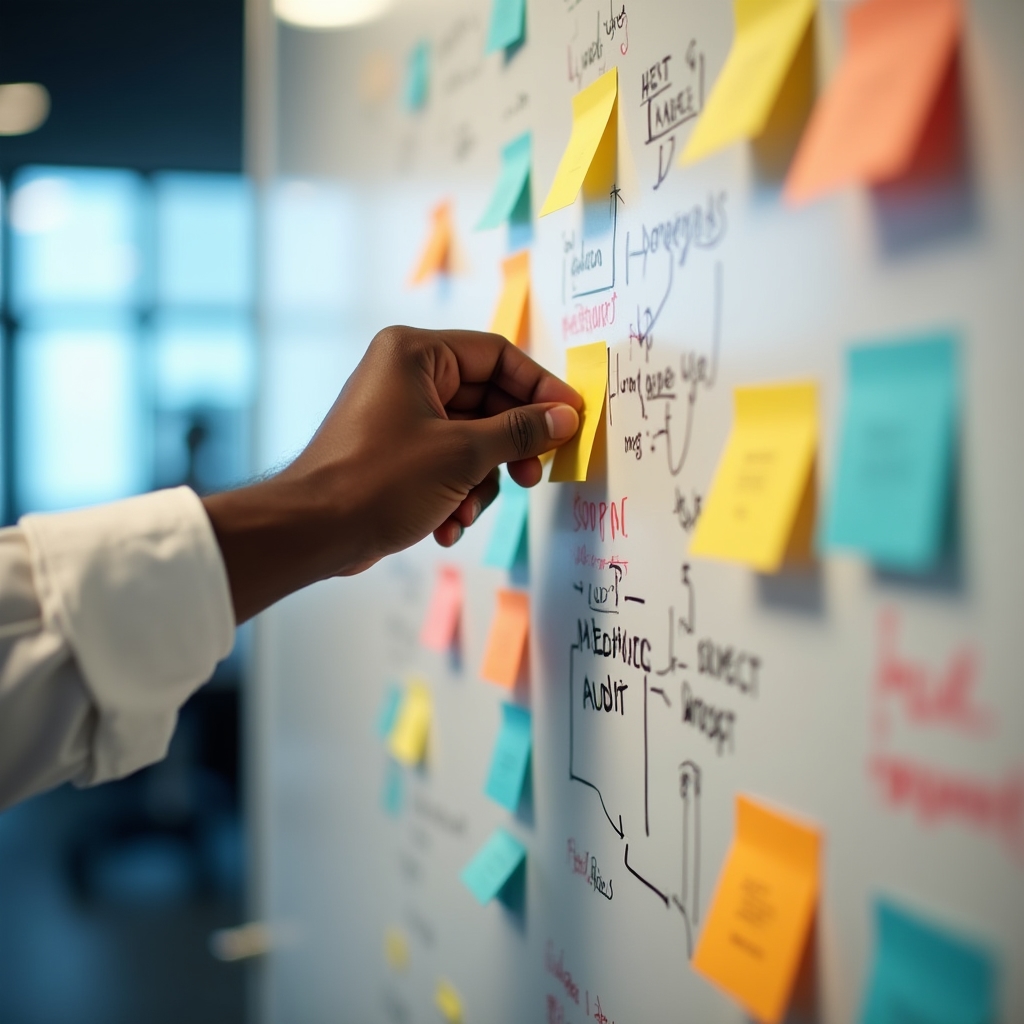
The training includes a meeting audit exercise: participants map their actual recurring meetings against what each one is meant to produce. Most audits surface at least a few meetings that exist purely out of habit.
From there, teams practise replacing status meetings with async updates, and redesigning the meetings that genuinely need real-time discussion so they run shorter and end with a written decision.
Five modules, delivered across a mix of self-paced material and live practice sessions. Teams move through them in sequence over several weeks.
Message structure, response-time norms, and writing updates that do not require a reply to be useful.
Structuring a shared knowledge base so it stays current instead of becoming an archive nobody opens.
Mapping existing meetings, identifying candidates for removal, and restructuring the ones that stay.
Assessing current tools against actual coordination needs, and identifying overlap and gaps.
Turning new practices into standing team norms, with a written playbook the team keeps after training ends.

Sessions are led by facilitators with backgrounds in distributed operations and technical program management, people who have run documentation systems and meeting redesigns inside their own teams before teaching them.
Each cohort works with a facilitator throughout the program, rather than moving between different presenters for each module. This keeps feedback consistent and lets the facilitator adapt exercises to the specific tools and habits of the team going through training.
Completion of the program is documented for internal HR or L&D records.
Issued to each participant who completes all five modules and the closing assessment.
Training hours are logged and can be included in internal professional development records.
Each certificate is countersigned by the facilitator who ran the cohort, not issued automatically.
A short applied assessment at the end of the program, reviewed individually by the facilitator.
The program is built for teams that work across more than one location or time zone, including fully remote teams and hybrid teams that split time between an office and home. It works for teams of any function, though most cohorts come from engineering, product, operations and marketing departments.
No. The training teaches principles that apply across tools. Exercises are adapted to whatever documentation and messaging tools your team already uses. If your team is deciding between tools, module four covers evaluation criteria rather than recommending a specific product.
Roughly half. Each module includes self-paced reading and exercises, followed by a shorter live session focused on discussion and applying the material to your team's real workflows. This mix mirrors the async-first approach the program teaches.
Single teams can go through the program on their own. Larger rollouts across a department or organization are also available, typically staggered across cohorts so facilitators can keep group sizes manageable. See the pricing page for how formats differ.
Each team leaves with a written playbook covering the norms and templates built during the program. Some formats include a short async check-in with the facilitator a few weeks after completion to review how the new habits are holding up.
Both. The core problem the program addresses, coordination that depends too heavily on everyone being available at the same time, shows up in fully remote and hybrid teams alike. Fully remote teams often notice the meeting-load issues sooner, but hybrid teams tend to have more inconsistent documentation habits since some information still travels by hallway conversation.
Get in touch to talk through formats, scheduling and how the program fits your team's current tools.
Start a Conversation